The Box She Left Behind
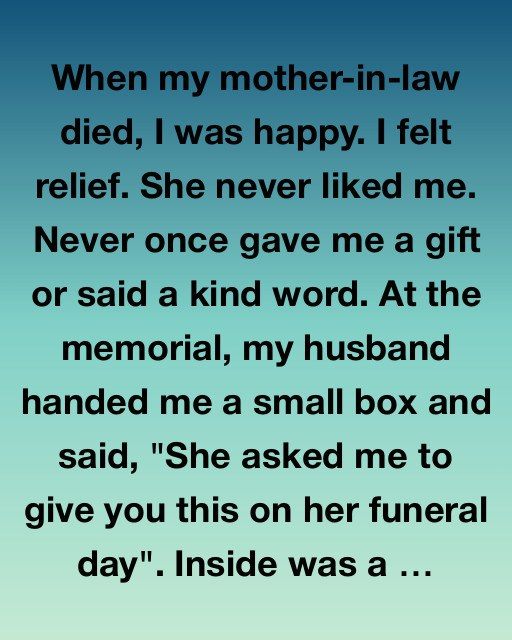
When my mother-in-law died, I didn’t cry. I felt relief — harsh but honest. She had never liked me, never offered a kind word or even the illusion of approval. Every holiday was tense, every dinner a quiet judgment. So yes, when she passed, I felt free. But at the memorial, my husband handed me a velvet box. “She wanted you to have this,” he whispered. “Open it alone.”
That night, I opened the box to find a silver necklace with a sapphire pendant and, on the back, my initials: L.T. Confused, I found a folded letter inside. In her sharp handwriting, she wrote that she had been wrong about me. She admitted she hadn’t hated who I was — she hated being reminded of who she used to be before she sacrificed herself to a loveless marriage. “I feared my son would ruin you the way his father ruined me,” she confessed. Her cruelty had been armor over old wounds.
The letter told the story of the necklace: a gift from a man she once loved, Lucas. The L was for him. The T she added for the daughter she never had. “In a strange way… I see her in you.” For the first time, I cried for her.
A week later, at the reading of her will, the lawyer handed me an envelope containing a brass key. I knew instantly what it unlocked: the attic she’d always kept off-limits. Inside were journals spanning decades — her dreams, her loneliness, her lost love, and the pieces of herself she’d buried.
She left me more than memories. A safety deposit box held a check for $40,000 and a note urging me to pursue my dreams. I used it to open a small art gallery, The Teardrop, named after the pendant.
Her forgotten paintings now hang there, drawing tears from strangers. Through her art, her voice finally speaks. And through her final act of honesty, she became the mother I never expected.
Sometimes the people who hurt us are protecting the most wounded parts of themselves. And sometimes forgiveness arrives quietly — in a letter, a key, a teardrop of blue stone.